Homicide Monday Morning on 83rd and Main Street, Possible Payback From Earlier Swans Killing

A 17-year-old black male was shot to death Monday morning on East 83rd Street and Main Street in what street sources are saying is likely a  "payback' for the killing of a Swan and a teenage girl Saturday night.

The youth was shot three times in his chest and was pronounced dead at the scene in a Main Street Crips neighborhood. 

Saturday night, shortly after 8 p.m., four people were shot by a man who exited a SUV and opened fired with an assault weapon near a liquor store at 81st Street and Avalon Boulevard, two of them fatally. The dead were Shujaa Silver II, 20, said to be known as  "Bad Ass" from Swans, a notorious Bloods gang, and 16-year-old Cy' Jai Bell. Two others were wounded and sustained non-life threatening injuries.

No further information is currently available on today's victim.

Anyone with information on the killings can anonymously call LAPD Criminal Gang Homicide Division at (323) 786-5100.

Swans Graffiti by "Bad Ass", whose tag is on far right.

Swans Graffiti by "Bad Ass", whose tag is on far right.

.

Four People Shot, Two Fatally, Saturday Night at 81st and Avalon

A young man and a teenage girl were shot to death and two others wounded by a man who exited a SUV and opened fire with an assault weapon in a gang-related shooting Saturday night a 81st Street and Avalon Boulevard. 

Shortly after 8 p.m., the shots rang out on the corner near liquor store. Shujaa Silver II, aka "Badass", a male black, age 20, was pronounced dead at the scene. Cy' Jai Bell, 16-years-old, was shot in the chest and  transported to California hospital where she was pronounced dead.

Two other black males, both in their 20s, sustained graze wounds to their backs and were transported to Californian and St Francis hospitals in fair but stable condition..

Police said victims and witnesses were being uncooperative and refused to provide any information. Street and police sources suspect a homicide Monday morning on 83rd and Main Street was payback for these killings. 

See for a little more info.    http://www.krikorianwrites.com/blog/2016/1/25/homicide-monday-morning-on-83rd-and-main-street-possible-payback-from-earlier-swans-killing

cops 81st.jpg


Four People Shot, Two Fatally, Saturday Night at 81st and Avalon

Two people were shot to death and two others wounded in a gang-related shooting Saturday night a 81st Street and Avalon Boulevard. 

Shortly after 8 p.m., the shots rang out on the corner near a liquor store. A male black in his 20s was pronounced dead at the scene. A female black in her 20s was shot in the chest and  transported to California hospital where she was pronounced dead.

Two other black males, both in their 20s, sustained graze wounds to their backs and were transported to Californian and St Francis hospitals in fair but stable condition..

Police said victims and witnesses were being uncooperative and refused to provide any information. 

qquor

qquor

LocoL Watts, A Soft Opening in a Hard Neighborhood Goes Beautifully

Location, location, location..  

That is said to be a major key to success when opening a restaurant. 

So where does Roy Choi open his newest venture, LocoL?  On 103rd, a street that during the 1965 Watts Riots became nationally known as "Charcoal Alley" and not for the coals used to grill steaks, but for the burning cinders of the torched buildings by African Americans pushed to the brink by mistreatment from law enforcement. To top that off, to defy the location, location, location pundits, it's a half block from Grape Street, which the mere - and threatening - mention of so often has preceded mayhem.  

But, on a dreary Monday afternoon, that location, 103rd and Grape, across the street from the Jordan Downs housing projects,  mighta been the most joyous, grateful and satisfied corner in this whole city.

"This is so good for the community," said Bow Wow,  a fixture in Jordan Downs, who is employed by LocoL as an "Ambassador".  The ambassador duties?  Well, let's just say Bow Wow, like any ambassador, represents the territory to other territories in a positive manner.

Some were in line to eat, Others were just hanging out, happy to be part of a celebration in a community that has seen so much sadness come its way. One of them was Daude Sherrills, who along with his brother Aqeela  - a prominent gang interventionist and owner/partner in this restaurant  - was one of the architects of the historic 1992 Watts Gang Peace Treaty. 

"This is what a community development business is all about," said Daude as he held court with old and new friends near LocoL's patio. "Plant the roots of the business deep in the community.  It won't tip over that way. There are 36 jobs here, and 99% of the workers are from Watts.  This is great."  

On Saturday, at LocoL's back patio, Nardo, another Jordan Downs stalwart who is employed here, was telling customers "It's a soft opening", He turned to a reporter he's known for decades who had chided him for that lingo.  "Hey, I'm learning the restaurant language."  

LocoL, which bills itself as a "revolutionary fast food restaurant", is the brainchild of Roy Choi and famed San Francisco chef Daniel Patterson. The next restaurant is set to open in SF's gritty Tenderloin district..   There's even one planned near the notorious Nickerson Gardens, a mile away from 103rd Street. . 

This is from Choi and Patterson  

"We are a company where the chefs think about what to feed you. Where the chefs think about how to take care of you. We fundamentally believe that wholesomeness, deliciousness and affordability don't have to be mutually exclusive concepts in fast food. We believe that fast food restaurants can truly empower the communities they currently underserve. We believe that the giant corporations that feed most of America have degraded our communities by maximizing profits over decades. We believe that chefs should feed America, and not suits."

Monday, one of Local's managers, well known as "Ready", was moving through the crowded restaurant with the ease of a maitre d' at Spago, greeting old friends, chatting up new ones.  "It's great to see you,"  "Welcome to LocoL." "Enjoy your meal." 

The line of customers went down Anzac Avenue for nearly a whole city block.They were not disappointed. 

"I'm not going to Burger King or McDonalds or Carl's Jr, anymore," said Dion Mangram, a life-long resident of Jordan Downs.  "This is my new restaurant, It's healthy and delicious and reasonable."  

Indeed, a fried chicken sandwich was four bucks and I'm craving it as I write this.   I might go back tonight.  Now, when I got to Watts  and I go often - LocoL will be my spot.

A local chef, Nancy Silverton, was at LocoL Monday afternoon and she raved about the hamburger and the chicken sandwich, but also about the concept. "This is delicious. I applaud Roy This is really something very special for our city."    

Inside, Roy Choi beamed when he saw a reporter who has covered Watts for 25 years.  They did a hard double-clutch handshake and - to the naysayers who doubted he could ever open on 103rd Street - he triumphantly roared  "Fuck 'em! Fuck 'em." 

It was the most beautiful restaurant opening I have ever attended.  And as tasty and healthy as the food is, LocoL is about location, location, location.

IMG_7454.JPG


Man, 46, Shot To Death Monday Night at 53rd Street and Compton Avenue

A 46-year-old man was shot and killed late Monday night as he was in the park at 53rd Street and Compton Avenue .  The victim, William Tyrone Moss, was shot in the back at least once at the Slauson Multipurpose Center at 11:08 p.m., and transported to USC Medical Center where he was pronounced dead. 

Anyone with information on the killing can call the LAP Newton Division at (323) 846-6547  

slausonMC.jpg


Appeals Court To Review Vindictive Prosecution Claim by Cleamon "Big Evil" Johnson's Lawyers, 3 Murder Charges Could Be Dropped

The California Court of Appeals will review a motion by defense lawyers of Cleamon "Big Evil" Johnson that argues their client is a victim of vindictive prosecution, a claim that if ruled in his favor would drop three of the five murder charges against the 89 Family Swan Bloods gang member.

Los Angeles Superior Court Judge Sam Ohta,  who is presiding over the case, had ruled against the motion in September, but the Court of Appeals agreed to review it, a decision that thrilled Johnson and his attorneys Robert Sanger and Victor Salerno

"This was very, very  good news," said Salerno.  He downplayed  any significance that the prosecution had asked for an extra week last Thursday to present their written case to the appeals court which is now due Dec. 18.  The defense will have an opportunity to respond to the prosecution's argument and the two sides could meet at the Ronald Reagan State Building to present their cases in February.  

According to a piece in the Yale Law Review,  legal "vindictiveness" does not refer to a prosecutor’s ill feeling toward, or even his desire to harm, a defendant. Rather, wrote Doug Lieb, a law clerk for the 9th Circuit U.S. Court of Appeals, "As defined by the Supreme Court,vindictiveness means that a prosecutor has retaliated against a defendant for the exercise of a legal right, denying his/her due process."  

Johnson spent more than 13 years on death row in San Quentin for the unrelated 1991 double murder of Donald Ray Loggins and Payton Beroit that he and co-defendant Michael "Fat Rat" Allen were found guilty of in 1997. That conviction was overturned in 2011 by the California Supreme Court which ruled that a juror, leaning toward acquittal, was wrongly removed by judge Charles E. Horan.

Johnson and Allen were sent back to the Los Angeles Men's Central Jail for a retrial  As they prepared to retry that 1991 case, the district attorney's office, aided by LAPD detectives,  set out to find additional cases to pin on Johnson.. They were given the luxury of time by the defendant's decision to waive their rights to a speedy trial  and the many subsequent delays in the case  LAPD detectives scoured the California penal system looking for inmates willing to testify against the man who is among the most famous gang members in the city's history.  

In addition to the two men - Payton Beroit and Donald Ray Loggins - shot to death at a car wash in 1991, the district attorney's office now alleges Georgia Denise "Nece" Jones, Albert Sutton and Tyrone Mosley were all killed or ordered killed by Johnson.  While Johnson was in Ironwood State Prison, Jones was shot and killed June 12, 1994 at 87th Place and Wadsworth Avenue in the 89 Family Swan neighborhood. Sutton was also killed in that neighborhood.  Mosley was shot and killed in September 15, 1991 on 97th Street and McKinley Avenue, a 97 East Coast Crips neighborhood.

Johnson, acting as his own lawyer,  was previously tried on the Mosley killing in 1998.. The result was a hung jury, well in his favor. 

If the court grants the vindictive prosecution appeal, Johnson and Allen would still face a trial on the original double murder case.  However, that case was not a ":slam 'dunk" and relied much on the testimony of one Freddie "FM" Jelks, himself a gang member facing prison who was killed many years ago in an unrelated incident on the west side.. 

Earlier in court, Johnson' lawyers sought to have Jelks' recorded testimony kept from being played back in court. Johnson's lead attorney Sanger, even threatened  - or joked  - he would go "Clint Eastwood" on an empty witness stand, a reference to the actor grilling an imaginary President Obama sitting on a chair at the 2012 Republican Convention 

Last year, Johnson told a visitor the extra charges were "bullshit." .    

"It's just more bullshit to keep me locked up, keep a trial going," said Johnson who is back in the regular high power section of the jail, after nearly a year in a special, segregated cell, (not for his own safety).  "They think when I get out, I'm going to go on some rampage. And the police tell people that. Man, I just want to be free. I'm someone who could help stop this violence."

Johnson claims to be a changed man. He told a visitor recently " I am not the same person I was when I went in here. I'm not Big Evil. I'm Cleamon Johnson."

"Have you ever heard of Dr. Bruce Banner?" the visitor asked him, referring to the Hulk's alter ego.

He broke into a gigantic laugh, "Don't make me angry. You wouldn't like me when I'm angry."


big+evil.jpg


Man Stabbed To Death Wednesday Morning in Highland Park, Two Female Suspects Sought

A male Hispanic was stabbed to death early Wednesday morning, possibly by two female Hispanics, the LAPD said today.  The man, said to be between 20 and 25 years old, was pronounced dead by paramedics near the intersection of Figueroa Street and Avenue 59 shortly before 2:30 a.m.. The two suspects may have fled in a black Dodge Charger.

Anyone with information can call the LAPD Northeast Division at ( 323) 344-5701


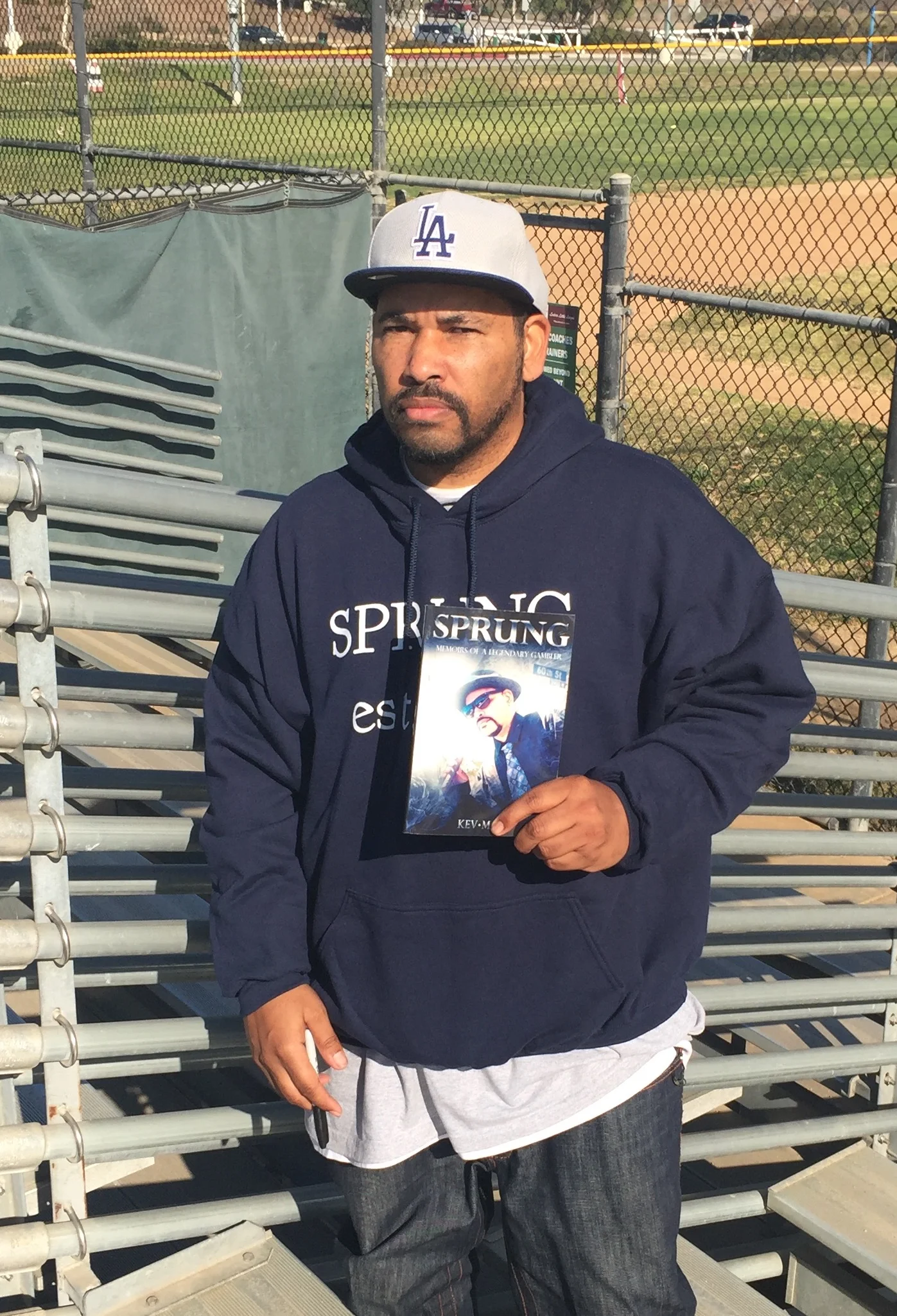
The New Book "Sprung" Tells The Riveting Story of the Legendary South L.A. Gambler Kev Mac

"Is it wrong to gamble or only to lose?" - Sky Masterson in "Guys and Dolls"

If Damon Runyon, the brilliant story teller of Broadway's gamblers, was alive and stepping in our town,, five would get you ten he be hanging out with Kev Mac, the most over-the-top dice shooter ever to come from the streets of South Los Angeles' deadly and intoxicating street gang world.

But, since Runyon's writing skills have dramatically diminished since his death 69 years today,  it was up to Kev Mac to pen his own stories and the result is the just-published "Sprung; Memoirs of a Legendary Gambler", 36 fascinating tales of a dice-throwing life winning and losing millions in the casinos of Las Vegas and in the backyards of south-central.

Kev Mac, 47  paints an often-thrilling - shooting dice with $52,000 at stake and winning  - and often-agonizing - too broke to buy gasoline - portrait of his life as a gambler. He talks about how his addiction was like that of an alcoholic where he would get the shakes when he didn't gamble and the only cure  - the equivalent of trembling drunk taking a drink - was throwing the dice.

Kev Mac,  a full fledged member of one of the country's most notorious street gangs, the Rollin' 60s Crips, writes his first taste of the gambling life came at age 12, when an older guy from the neighborhood, Chipper, known for his skill with the old Intellivision baseball game, invited him to his house at 57th and Harcourt to play a game. Kev Mac won and  Chipper's friends fell out laughing at him. Infuriated, Chipper demanded to bet  Kev $20 he would win the rematch.  In Sprung's first chapter,  "A Gambler In The Making",  he describes his reaction.   "Twenty dollars?!" I asked in my Dennis the Menace voice. "You've got a deal".

You know what happened.  Kev Mac gambling career had started out with a win. As he writes "Not only did this event spark the great "Kev vs. Chipper" games, it also introduced me to the seedy world of serious gambling."

But, it was  nine years years later, at age, 21, when his father took him to the Stardust Hotel in Las Vegas when the love affair - or pure infatuation - with dice began. Though the trip was a financial loser, it changed Kev Mac's life.  On the ride back to Los Angeles he says his "competitive nature came to the forefront and my 'I can't be defeated' attitude was born." 

He had been defeated at the Stardust, but he was determined to get even.  "It's just like the streets," he explains. "When a guy beats you up, you gotta go back and get even. "

Kev Mac, proud Rollin' 60s Crip, often wearing their symbolic blue Seattle Mariners cap with an  emblazoned "S" ( for, in his case, 60s) would fearlessly - or blindly - cross  gang boundaries to attend crap games, even if they were in Bloods-dominated areas, most often in Rollin 20s Bloods hood.

Not only would he have to contend with rival gang members  the LAPD was a constant  threat. 

Whereas Sky Masterson, and his cronies Nathan Detroit, Nicely NIcely Johnson and  Harry the Horse had to deal with Lt.  Brannigan, Kev Mac and company faced a far more perilous threat, LAPD's hard chargin CRASH units.  In one story set on Brynhurst - the Rollin's 60s most notorious street -   he write of how the police would often disrupt the craps games.  "Police officer from the 77th Street Division were always turnt up,. speeding down the blocc, jumping out with their pistols aimed at us. How's a brother 'spose to roll a seven with a nine pointed at this head?"

The Six-Oh life is peppered throughout. This has to be the only book on gambling that has a chapter that begins with "While awaiting trial for a home invasion robbery in the gang module of the L.A. County jail, I turned to spades betting. "   Kev Mac did some years for that robbery which was at the home of former  NBA player Benoit Benjamin.

When he  got out, he amped up his bets. Many times Kev threw the dice with $52,000 on the table. Often he won. But, like the classic addict, he could rarely walk away form the table

"I won millions and I lost millions," he said as he looked out last week at the old Summit Field baseball diamond in Ladera Heights where he played left field as a kid.  "I was constantly fighting myself, not only after I lost a bet, but after I won one. I'd want more. And lose? I couldn't accept to lose. I'd be up tens of thousands and start to lose it and try and get it back and lost it all. Lotta times my life was a nightmare"

Through much of it, Kev had a full time job as a school bus driver, making $10 an hour. But, the cash he had on hand was no bus driver money. "I had cash stashed under the mattress, in pillowcases, even in the Encyclopedia Britannica." 

When the times were good, and when Kev was single, he had to have a female escort and Las Vegas was loaded with hookers. Kev Mac eloquently explains the difference between an expensive hooker and a moderately price one – their purse. "A thousand dollar pussy and a hundred dollar pussy is the same thing. One might have a Luis Vuitton purse and the other a Mary Kaye purse, but that's about it.  I've had a lot of good times with both." 

Lots of those good times were courtesy of his sports heroes and the money he won betting on them  He cites John Elway, Steve Young, Brett Favre and Warren Moon as his biggest money makers  But, on one notable occasion Moon let him down after building him up

He writes of a chapter where he took Shana, the mother of his son, to Vegas for a getaway and some sports betting. The football game he bet on – a famous 1993 playoff game between Moon's Houston Oilers and the Buffalo Bills started out wonderfully.  The Oilers were ahead 35-3 in the second half and Kev promised to buy her anything she wanted.  Shana pointed to a huge stuff lion with a $700 price tag. He nodded.

"Are you really gonna buy me a $700 stuffed animal?", Shana asked.

"I'll buy you whatever you want."

Then the gridiron horror began for Kev. The Bills mounted probably the greatest comeback in NFL playoff history winning in overtime 41-38. Suffice to say, the rest of the trip didn't go so well.

That game was 22 years ago. Kev quit throwing dice in 2012, but he still bets on sports. He shows off  the winning ticket of a Nov. 19 when he won $9,000 on football games

Still, that money is long gone.

"It's almost like I'm not happy til i'm broke. I have that trait of most gamblers. I'm greedy. I'm enjoying the lifestyle, but then I'm not enjoying the life style.  it's really fun and sad at the same time." 

To buy "Sprung" check this link. The book is only $11 and it might just save you thousands at the crap table. 

http://www.amazon.com/Sprung-Memoirs-Legendary-Kev-Mac/dp/0692540172/ref=sr_1_1?s=dmusic&ie=UTF8&qid=1449602972&sr=8-1&keywords=sprung++kev+mac

kev mac


War and Peace in Watts, Part 2 of the Classic LA Weekly Article

Ronald “Kartoon” Antwine is sitting in his garage, looking out at the Union Pacific railroad tracks near 114th and Wilmington Avenue. Kartoon is one of the legendary Bounty Hunters. A former menace to society. A 6-foot-4½-inch, 260-pound thug who carried a pistol in one pocket and a sawed-off Winchester pump shotgun under his black leather jacket. He robbed people, shot people, beat up people in the wild days of the ’70s.

He paid for his crimes by doing more than 15 years at the toughest prisons in California, including thousands of days at Folsom back when Folsom made the Pelican Bay of today seem like juvenile hall. He walked out of prison in 1992 and has not been back.

Just days after he left Chuckawalla Valley State Prison in Blythe (“America’s Hottest Prison”), the peace treaty was being negotiated, and Kartoon became a key representative for the Bounty Hunters and Nickerson Gardens. He recalls that one of the biggest sticking points was that the Crips — PJs and Grape Street — were concerned about their safety in his Blood neighborhood.

“One day I said, ‘Let’s find out,’ and we all started walking through the Nickersons, Bloods and Crips. The young homies were stunned, but they joined in. It was beautiful.”

These days, Kartoon is a gifted writer, a Bounty Hunter historian, a community activist, and still a respected figure in Nickerson Gardens. “You see that field right there by the tracks?” he asks, pointing 50 feet away. “That used to be our Vietnam. That was the frontlines. That was the border between the Bounty Hunters and the PJs. There used to be weeds higher than me there, and we’d be sniping at them from our side and they’d be sniping at us from their side.”

But now that the PJs and Bounty Hunters are getting along, the weeds are gone, and so is the fear of gunfire. “I sit in this garage and it’s a pleasure to see the people cross the tracks, crossing enemy lines. It’s like walking through a force field on Star Trek. Used to be you cross those tracks, you die. Now people walk back and forth.”

Kartoon, 46, partly blames the local government and the lack of resources available to help stop the violence. But Kartoon (Bloods disdain the letter C) reserves his harshest words for those whom he considers the cause of the treaty’s demise and the latest upsurge in violence by young, reactionary gangsters. “All the projects are doing their part to stop the violence, but every project has those reactionaries who listen to no one and don’t want to participate in the peace movement,” he says. “All we ask is they don’t sabotage the peace. It’s like in Baghdad. They got that one religious sect doing all the bombing. But, the other sect refuses to retaliate.”

Kartoon says he’s been in the Nickersons during and after recent shootings. With other hall-of-fame Bounty Hunters Big Hank and Big Donny he tried to persuade the young homies not to retaliate. “Our young guys were saying, 'Fuck this. We gonna do something.' So Hank and Donny and everybody, we had to calm them. It’s not an easy thing to do.”

He doesn’t tell young Bounty Hunters what to do — to attack or not to attack — but rather emphasizes the consequences of their actions.

"All the guys getting busted, they don’t realize what a life sentence is. When the pop goes off, when their head pops out of their ass and they realize they ain’t going home after just five years. When they realize they’ll never be able to taste a Big Mac or a Quarter Pounder again. To see them go crazy when they hear their moms is dying and they’re locked up and can’t go see her. When they hear their woman is pregnant by their best homeboy. When they realize they’ll never see a night sky again."

As I’m driving one evening through the 1,066-unit Nickerson Gardens, said to be the largest housing project west of the Mississippi, dozens of men and women are milling about, and children are playing near their apartment units, many of them with small, nicely tended gardens with roses in full spring bloom.

For anyone who has ever seen the nation’s worst housing projects, such as the now-destroyed, infamous Robert Taylor Homes on the South Side of Chicago, the projects in Watts look almost pleasant during a quick drive-through. They are not high-rise prisons like Robert Taylor, Cabrini Green or Rockwell Gardens, but rather two-story buildings with small patches of lawn in front of them. A closer look, however, reveals the poverty and aura of hopelessness.

The Los Angeles city attorney has imposed a gang injunction against the Bounty Hunters here that makes it a misdemeanor for any of them to be together, although it is impossible to enforce all the time. In part of the city attorney’s report, LAPD Officer Victor Ross, one of the most hated men in Nickerson Gardens, writes, "When gang members are stopped by law enforcement they will say that they are going to visit their grandmothers, but in fact they are just hanging out with a bunch of other gang members, drinking, using drugs, playing loud music, gambling, loitering to be hooks or lookouts. They are doing anything but visiting their grandmothers."

Officer Ross describes a few gang members, like Aubrey Anderson, known as "Lunatic" or simply "Tic." "He is feared in the sense that he is short-tempered and is seen as crazy enough to do anything. He is not afraid to commit violence to further the gang." Another one is Israel Jauregui, a.k.a. Izzy, who has a tattoo on his arm that says, "Kill or Be Killed." "He is a violent gang member who is not afraid to commit shootings or other violent acts for the gang." Izzy, it turns out, is in federal custody now, and attempts to contact Lunatic were unsuccessful, much to the delight of my family.

Of the three projects in Watts, Imperial Courts appears the most run-down. The blue and green buildings that house 490 units look tired. Trash is rampant, flowers are few, and packs of young men evil-eye every stranger.

At Imperial Courts Recreation Center, which has a shiny full-size basketball court, no one is in the gym. But the narrow streets are full of young men. No one wants to talk about the breakdown of the truce. The four most common responses are "I’m not from here," "I’m just visiting," "Fuck off" and "Talk to PJ Steve."

PJ Steve is Steven Myrick, a tall, well-built 39-year-old who’s been a Crip almost his entire life, did nine years for kidnapping, robbery and assault, and has 2-inch-tall letters, "P" and "J," tattooed on his throat.

When PJ Steve heard about the 1992 treaty, he had mixed emotions.

"I was locked up when the peace treaty happened, and I was confused about it for a while. I couldn’t get it," says PJ Steve. "But then you realize it was a move for the kids. Kids need a better way than the way we had it. But now you got kids going back to the same ways.

PJ Crip "Cornbread" chimes in that he doesn’t feel safe in Jordan Downs.

In Jordan Downs, a group of Grape Streeters talk about the breakdown of the treaty, and the future. "I didn’t really like the peace treaty anyway," says Scrap, 29. "If I kill you today, then one of your homies who’s like 11 or 12 now is gonna remember it, and when he gets older he’s gonna blow my head off. That’s what’s happening today."

There is some hope in Jordan Downs that the infamous Grape Street shot caller Wayne "Honcho" Day may soon be free after serving nine years in federal prison on drug distribution and conspiracy charges. Day, now 48, was sentenced to more than 19 years, but he successfully appealed on the basis that he was poorly represented, and a decision on whether to reduce his sentence will be made within a month or so, according to Assistant U.S. Attorney Michael Terrell.

In a 1997 speech by Steven R. Wiley, then chief of the Violent Crimes and Major Offenders section of the FBI, Honcho was called "the Godfather of Watts." That’s a slight exaggeration, but when told that Honcho may be getting out of prison soon, both Kartoon and PJ Steve consider it good news.

"If Honcho was here, this wouldn’t be happening," says Kartoon.

Sitting on a wooden table near the closed Jordan Downs gymnasium on a fine spring afternoon as his friends prepare to barbecue and play baseball, Honcho’s nephew Kmond Day lays part of the blame for the violence on alcohol.

"Alcohol is not for peace," he says. "But some people drink cuz there’s nothing else to do. The reality is, if we have guys from our own hood who get high and we can’t control them here, how can we expect them to go to other hoods and not act stupid?"

But Kmond says most gang members don’t even know why they bang.

"A lot of so-called gang members could win Oscars. They’re acting like gang members. They’re doing the stuff gang members do — shooting, killing — but they don’t even know the whole purpose of representing the hood. If you ask them why they bang, they say, 'To represent the hood.' Represent what? There is no point in representing the hood. What’s the purpose? There is no purpose."

Many young kids gangbang out of fear, not fear of the other hoods but fear from guys from their own block.

"You got cats that’s killing cats from other projects, and the homies that are with them are afraid of them, so they try to impress their big homies," says Kmond. "But really, they are just scared. But they think it’s the only way to survive."

Some complain bitterly about what they consider the rough tactics of one LAPD officer, Christian Mrakich. They claim he harasses people and encourages the gang wars. "Mrakich is the Rafael Perez of Jordan Downs," says Daude Sherrills.

Captain Sergio Diaz says he has received several complaints about "an officer" in Jordan Downs, but nothing has been substantiated.

"While I can’t talk about personnel investigations, I will tell you, in the course of a criminal investigation earlier this year, we know from wiretaps that targets of these narcotics investigations encouraged each other to make complaints about a specific officer who they knew to be investigating them," Diaz says. "We checked them out and concluded he had done nothing wrong."

Attempts to interview Mrakich are rejected by the LAPD, but his commander laughs when told that many gang members spoke badly of the officer.

"We have a lot of bad things to say about Grape Street, too," says Captain Diaz. "They are killers, dope dealers and robbers. Mrakich and [Victor] Ross are very effective in the projects, and of course many people hate them, quite naturally."

Unlike some in the LAPD, Diaz praises the now-fallen peace treaty.

"There was a lot of skepticism in the department about the treaty, but I believe it made a significant difference in the violent-crime rate," says Diaz.

"Obviously, the truce thing was good in that people weren’t shooting each other. But now, unfortunately, that is over."

On the evening of April 9, Officers Oscar Ontiveros and Darren Stauffer, from Diaz’s Southeast Division, are involved in a shooting that kills Bounty Hunter Spencer "Fox" Johnson after, they say, he pointed an assault rifle at them near Bellhaven and 112th streets. Gang sources say Fox was on the lookout for a Grape Street attack at the time.

In the early-morning hours of May 9, another Bounty Hunter, Kemal Hutcherson, 24, is gunned down — not by police — on perhaps the most cruelly named street in the city, Success Avenue.

Though it has a nationwide bad rep (and this story won’t make it any better), citizens who live here have a great deal of pride in Watts. I’ve never heard anyone boast, "Man, I’m from Bel Air," but folks seem almost eager to tell you they’re from Watts. And because of their resiliency, and because of the mostly good memories of the 1992 treaty, there is much hope that this current battle of the projects will not be left to fester and maim and kill for years.

In the last two weeks there has been a call to fight the good fight. Not to cave in to the violence and accept it as in days of yore. Not to just be outraged when a cop kills a black kid, but be outraged when a black kid kills a black kid.

In the projects, a new group of respected, slightly older gang members — not just famous triple O.G.s like Big Hank from the Nickersons or Elementary from Grape Street, but adults in their mid-20s and -30s, men and women who are trying to reach the youngsters and quell the killings — have emerged.

One of those young men is Bow Wow from Grape Street, who has been meeting with his counterparts from the other projects and reporting back to the young homies.

"We need to keep conversating," says Bow Wow. "There’s a new leadership, and we just need to keep talking and not shooting."

The older guys can help, but much hope is put on the new generation of leaders.

"We are dealing with a new generation who are trying to maintain the tradition of peace, trying to make a difference in a positive way," says Gregory Thomas, supervisor of those gang-intervention workers at CSDI. "Young brothers with respect. Guys that have been through a lot and changed."

The spirit behind the new leadership is that the new violence has heaved the responsibility for peace on the newer generation, and a lot of younger men are stepping up in an effort to stop this madness. They are trying, for example, to prevent a 15-year-old from getting into a car with an AK-47 and shooting another black boy because he lives in a housing project that is similar to his own but has a different name.

"This is not about the Nickerson Gardens or the Jordan Downs or the Imperial Courts," says Michelle Irving, a former Sybil Brand regular turned gang-intervention worker. "Those are just names someone gave three housing projects."

Citing the same impetus that was behind the 1992 treaty, the adults say they are doing this for the children. "It’s sad to see a young person walking down the street worried about if he or she is going to get shot," says Irving, who was "a mother and father at age 14." "They should be walking down the street thinking about school. Thinking about a future. A bright one."

As Aqueela puts it, "Peace is not a destination. It’s a journey with peaks and valleys along the way."

In Watts, that journey just might be never-ending. But at least there’ll be a whole lot of people along for the ride.