‘THE WATTS ARMENIAN’ MY CROWNING MOMENT AS A JOURNALIST

Something happened one week ago, Friday, May 1, 2026, that was the single most gratifying moment of my up and down career as a journalist.

If this had occurred anywhere it would have been a treasure, but it just so happened at the very place where I became a journalist and started working for the L.A. Times 34 years ago; the Los Angeles City Council chambers at City Hall.

On that Friday, the city was officially honoring the Watts Gang Truce of 1992. Why it took 34 years to do this is not to my understanding, but they did. They surely have done this before. This treaty, primarily between the Grape Street Crips from Jordan Downs housing project, the Bounty Hunter Bloods from Nickerson Gardens housing project, and the PJ Crips from Imperial Courts housing project, was historic. It was a nearly mythical peace truce between gangs that had been killing each other for two decades and who had national - even international - badass reputations.

I got word of this honoring a few days before when George Thomas, aka Bogard of Imperial Courts - Tony’s brother, if you know - called to give me a heads up about the City Hall event. That Friday rolls around and I was about to go home after having coffee in the distant land of Larchmont Village when I remembered Bogard’s call. ShouId I go? I thought to myself. Hmmm. I might as well. Man, am I glad I did. For if I hadn’t, that “crowning moment” in the headline of this story would have never happened.

I walk into the City Hall and the City Council chambers and flash back to my days covering the Tuesday, Wednesday and Friday meetings as a stringer for the Times. ( Thanks to my cousin Greg, a staff writer who got me the gig.) For the record, I wrote a terse recap of the meetings and got paid $60 a week. Not a misprint. Sixty. But, and this is key, I got to write that recap in the vivacious heart of the newsroom. Cutting to the chase, that led me to eventually covering Watts. My pod mate back in the mid-1990s was Matea Gold and she covered East L.A. and Boyle Heights. I called her the East L.A. Bureau Chief and she called me the Watts Bureau Chief.

Anyway, last Friday, after 30, 40 minutes of City Council stuff they get to the guys from Watts who are honored.

Daude Sherrills is one of the speakers. Him and his brother Aqeela, representing Grape Street Crips from Jordan Downs, were two of prime architects of the Truce. They went so far as to study a treaty between Egypt and Israel back in 1948-49.

Big Hank and Big Donnie from the Nickersons were there, too, as well as Sista Soulja aka Big Mama from Imperial Courts.

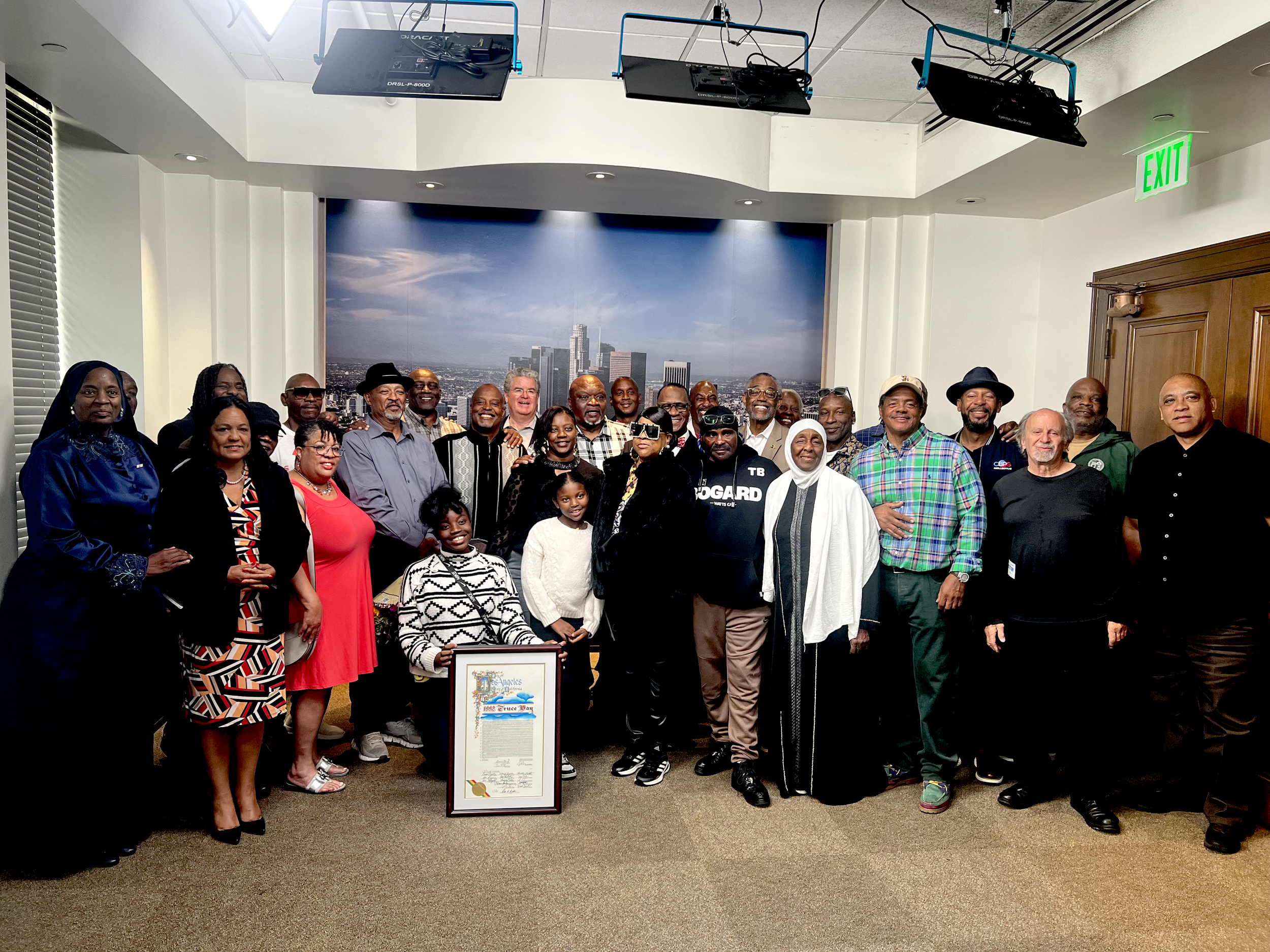
After that ceremony, they moved to a room next to the chambers and all gathered for the City Council photographer.
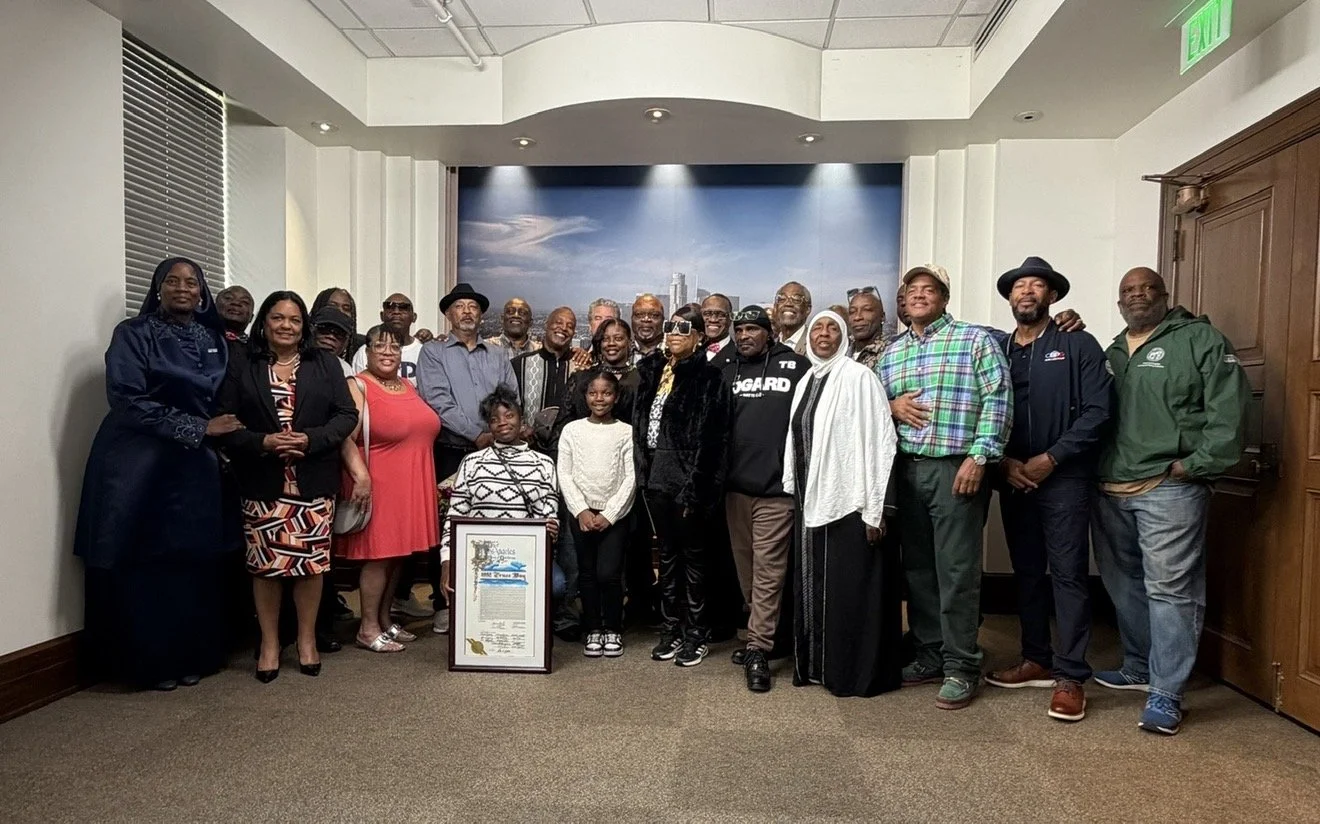
About 10 seconds after this photograph above was taken is when my shining moment flared.

Several of the guys, Daude and Aqeela, Big Hank and Big Donnie, Sista Soulja and others shouted out to me to join the group getting photographed.

“Yo Mike, get on up here.”

“Mother fuck, Mike. What you doing? You need to get on up here.”

“Negro, you the Watts Armenian. Get in this photo.”

“Hey, Black Armenian. Why you not up here?”

A wonderful feeling swept through me. No, it didn’t “sweep through.” The feeling came in me and stayed. A week later it’s still in my soul as i type this. And suspect it always will be.
Watts and I go way way back.

On August 12, 1965 I was in the small backyard of my family’s home on St. Andrews Place in Gardena playing my version of the World Series. Koufax was pitching to Mantle. Sandy was my left hand tossing up an nut or acorn or something from our Italian cypress tree and Mickey was me swinging, right handed, with a red plastic bat.

My mom comes out of the back door and yells “Michael! Telephone. It’s coach Charlie.”

I dash inside to hear Charlie, my little league baseball coach, tell me about an emergency meeting at Recreation Park on Normandie in Gardena, where our team, the Pirates, had recently won the park’s title and were moving on to the city wide baseball champions.

Charlie told me a lie, I’m sure. He said to come to the park for a meeting. I played along. Okay, coach. I’ll be there.”

But I knew the real reason for this “emergency meeting”. It was because that day was August 12, 1965 was my 11th birthday. And I “knew” the meeting was to be a surprise birthday gathering for me. After all, I was the first baseman and relief pitcher and had been named to the All Star team. All those games I played alone in the backyard. All those playing catch with my dad Tony had paid off.

So I went to the park and we all gathered. I was so proud .

And then Charlie said it.  I hear it as I type this like I did 61 years ago.

“The city championships have been canceled. Riots broke out last night in Watts.”

Watts?  I like to think I looked northeast about three miles and saw smoke rising. But, I really don’t remember my thought other than being stunned. I could quite possibly have said “Watts? What the hell is Watts?”

About three years later, my cousins and I jumped on the caboose a slow moving freight train in East Gardena. A train worker came out and said “I don’t care if you’re on this train, but I gotta tell you this train is going to Watts.” We jumped off.

About six years later, I was a driver at a print shop on 166th and Western. One of the printers was having a birthday party. He invited me, but added “You need to know the party is in Watts.” I went, had a blast and been coming back every since.

Yeah, a couple decades of covering Watts, of being there in dark times, of writing to prison inmates from there, of going there when nothing was happening, of going to funerals and parties, they all came together in this glorious moment of being asked, of being told, to get in this photo.

Though he wasn’t there, DeWayne Holmes, aka “Snipe” from the PJs, who was instrumental in the peace talks, called me Monday to say the photograph was beautiful. “Mike, you was always there for us,” he said. “Some came and went but you was always there. And tell Loaf I said ‘Watts up’ when you see him in the Nickersons for that Tuesday food giveaway.”

Yeah, I’m still going to Watts.

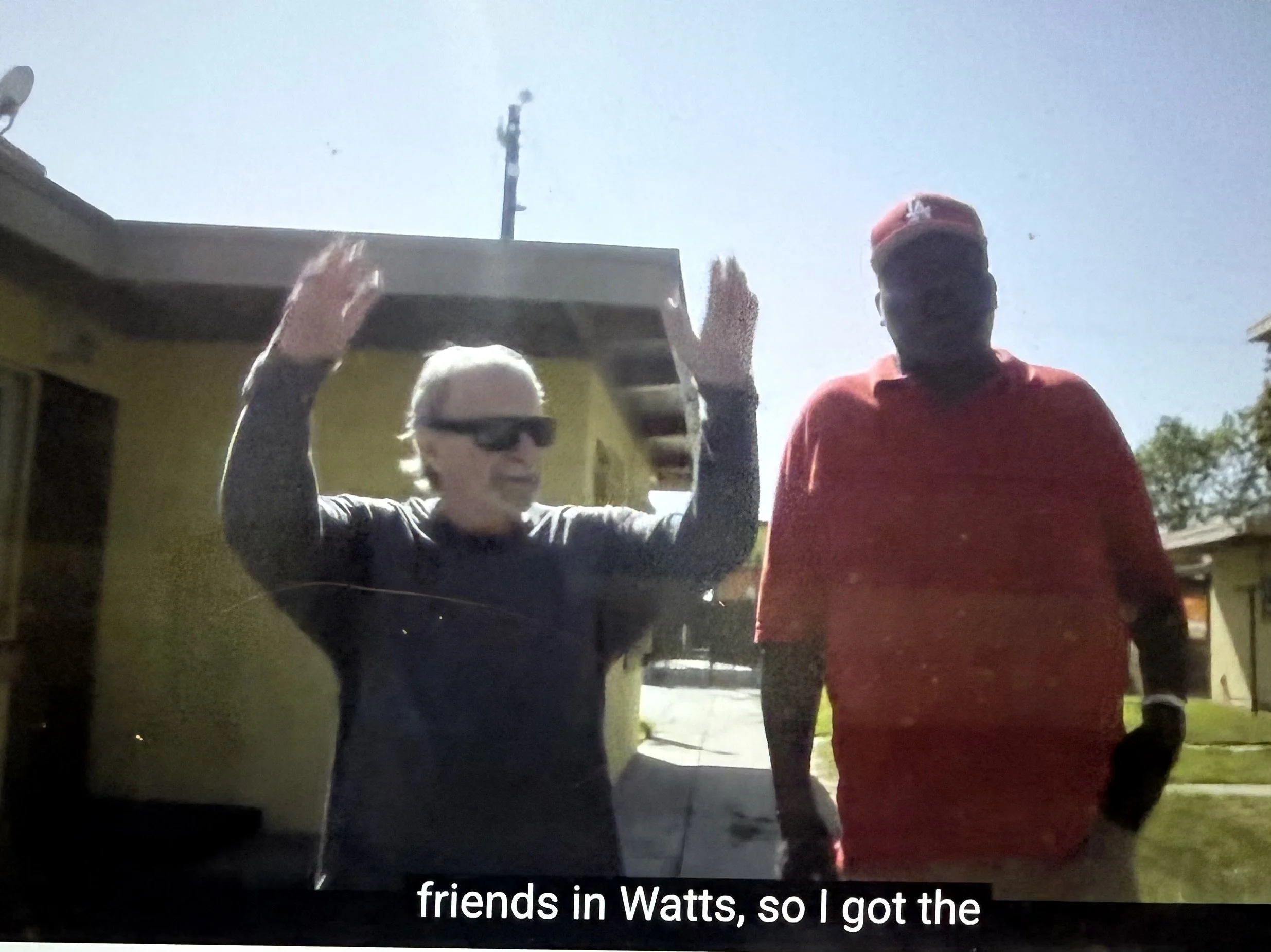
In 2023, PBS set out to do a documentary about Watts. When they started, they had a big problem. The shot callers would not let them into the projects with their cameras. PBS came to me. “Can you get us in?” I did. Check out “10 Days in Watts”, Episode 3. Here. https://www.pbs.org/video/watts-pride-ivqjow/. If you in a hurry to see the Watts Armenian.. and Kartoon.. fast forward to about 5 minutes, 50 seconds in.
NOT PRETTI GOOD, MARCHERS GET “NOT PRETTI GOOD” SIGNS

NOT PRETTI GOOD

 It would be pretty good and actually pretty damn easy to lower the tensions, the cuss word outrage emanating from Minnesota after the shooting death of Alex Pretti.

If that person in the White House simply called out the scaredy cat gutless coward Border Patrol agents who shot Pretti on a Minneapolis street last Saturday morning, that alone would help the country. In fact, if the President just immediately fired these people, it would be the greatest act of his presidency. Even more than acquiring Greenland. Just call the border agents cowards and it would help this nation. As in, “Well at least they called these guys what they are and fired them.”

I’m an old school gang reporter in Los Angeles, the gang capital of America. If Raymond Washington, the founder of the Crips, had seen what these punk ass border agents had done, he woulda called them cowards plus and beat the shit out of them.

When I saw the video, Pretti protecting the woman and then within two seconds, the five or six or seven agents against him and saw him get shot, it was maddening. But when I heard Alex Pretti was an ICU nurse at the Veteran’s Administration hospital my anger my outrage redlined.  I can’t remember when I felt like this about a single shooting. And I’ve been around my share of shootings.

If Alex Pretti worked at candy store or a gas station it would be horrible too, of course. But that VA thing seems to turbo charge the madness of all of this. The VA! He took care of our soldiers who were ill. My father and uncles were at the VA many, many times. My dad, a World War 2 Army Air Corps pilot, died at the VA in Westwood. And here is a ICU nurse from the VA getting shot by United States agents.

Bruce Springsteen – the only star I have heard speak out against this ICE stuff, telling them to “get the fuck outta Minnesota”  – came out with a song Wednesday called “Streets of Minneapolis.” Thank you, Bruce.

Shiftin gears, less than an hour after first seeing the video last Saturday afternoon, I had to get ready to meet my girlfriend at a benefit for the fire victims. I put on a shirt that didn’t work then tried on a maroon pullover that worked. I thought to myself “that looks pretty good.”

 Immediately it hit me. Pretti Good. Renee Good had been the woman shot to death by ICE agent 17 days before Pretti. And now Pretti had been killed. Pretti. Good. Not pretty good.

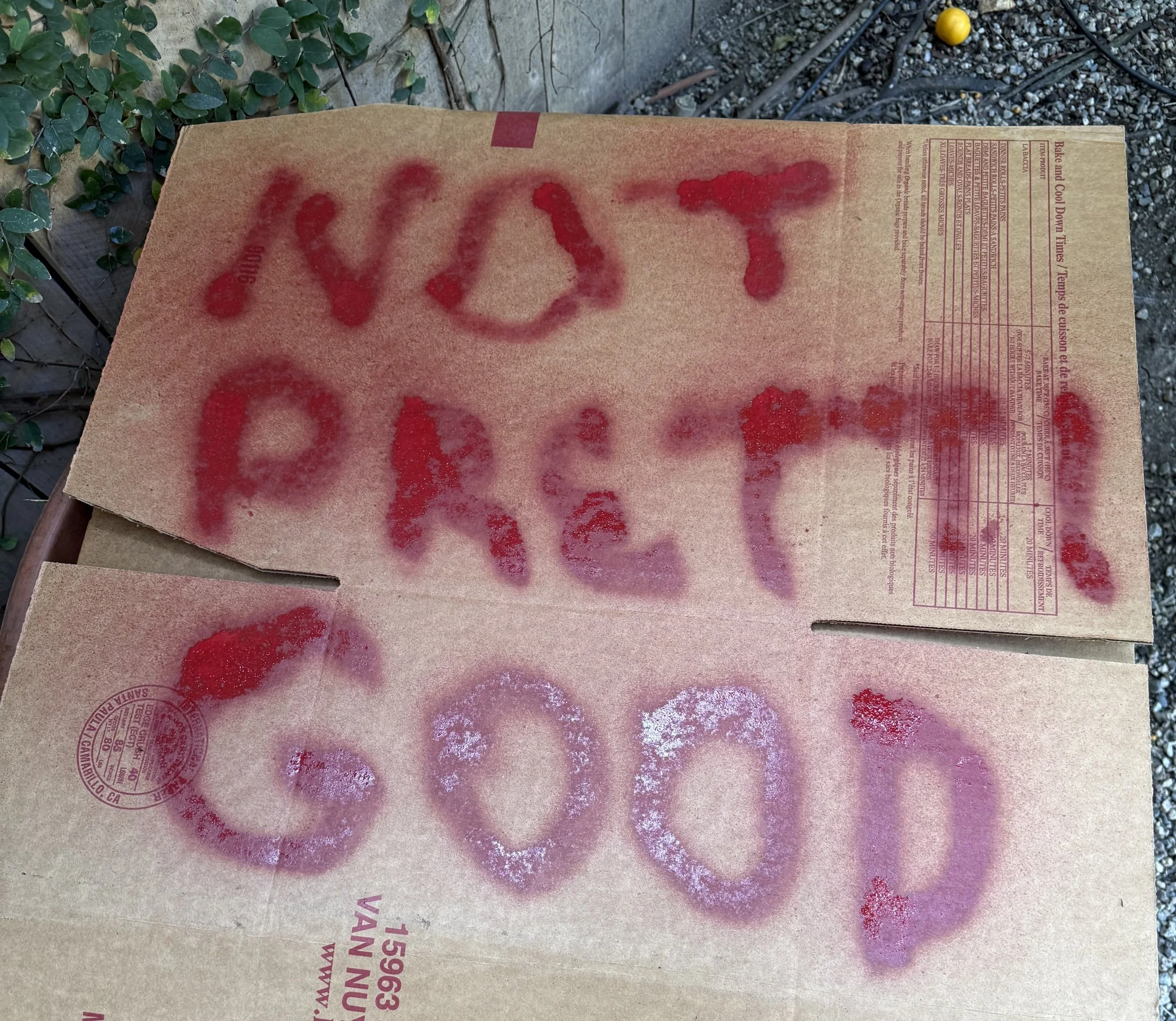
Not Pretti Good. I kept thinking that. And I thought, I don’t know, frustrated that I couldn’t really do anything, I figured about the only thing I could do was write this and hope maybe people would start protesting with signs that read Not Pretti Good. Not Pretti Good.

I went to our garage, found a cardboard box and spray painted it. Clearly, I’m rusty. But i envisioned hundreds, thousands of cardboard or wooded signs that read that. Billboards. A movement. Not Pretti Good. I see an aerial shot of demonstrations with a sea of Not Pretti Good.

Everyone should be against this one. Even the Border Guards should speak out themselves against this. At the Veteran’s Administration in Minneapolis, maybe someday they might name something after Alex Pretti. And no, that won’t be pretty good.


FAREWELL TO GREGORY "BATMAN" DAVIS, AN OG BEFORE THERE WERE OGs

“It was never about the destination. It was always about the journey.” - Bogard, aka George Thomas talking about Gregory “Batman” Davis

On the streets of Greater Los Angeles – and most of the United States now -  “OG” means Original Gangster. But those initials - and those words - are thrown about without the proper respect the term really  implies and deserves. There are 19-year-olds who are labeled OGs who, tough as they may, are not OGs.

There are even what is known as Triple OGs. Many of them are old friends. These are gang members who have been around 20, 30, even 40 years.

 However, truth be told, the truly Original Gangsters from Watts, South Central, Compton, Gardena and Inglewood were around long before the term OG was even invented.

 I say all this to get to Gregory “Batman” Davis. There would have to be a new term invented to properly classify him.

 No one disputes that the Crips were founded by Raymond Washington, a 16-year-old who grew up on 76th street and Wadsworth Avenue, which is a block west of Central Avenue,  around 1969. Check this 2005 LA Weekly article https://www.laweekly.com/tookies-mistaken-identity/

 One of the founding members with Raymond of the gang that was originally titled Baby Cribs, (too long a story to explain here, but read that above article I wrote) was Gregory Davis. Make that Gregory “Batman” Davis.

Davis passed away a month ago at age 69 and this Saturday, May 3, is his funeral. However, the cemetery he is to be buried in, Corona Sunnyslope, needs more money than the family currently has to dig the dirt and put it back, his sister told me

 “We have the plot, but it’s more money than we have to do the actually digging and putting his casket in the ground,” said Deborah Davis-Sampson.   “Anyone who can help out will be truly appreciated.”

Anything will help, she said.

Briefly on Batman, who was born in 1955 and got his name from his love of the television show “Batman” which was on ABC Channel 7 from 1966 to 1968 and starred Adam West as Batman, aka Bruce Wayne.  Gregory loved that show.

 And when Raymond formed the Crips, Gregory was an original member and, after a brief run with another nickname, became Batman. He envisioned himself like the fictional Batman, someone coming to the rescue.

Batman fought and shot for his hood. He did time for his crimes. But Gregory Batman Davis was one of those classic cases who turned his life around and became devoted to, classically, not wanting the younger ones to go through what he and Raymond and everyone in the “Crips” and “Bloods” went through.

“Batman dispised the gang culture of today and things done in the past glorifying death,” said Melvin Farmer, aka Skull, an original Westside Crip and co-founder of Gangster Crips. “He didn’t want today’s youth going through what we went through.”

 He fervently taught kids that education was the way to go.

 So much so that he was honored in 2000 by President Bill Clinton for his work in trying to keep kids out of gangs. Along with Chiquita Tolton, Gregory was honored at “Let’s Save the Babies” as Man of the Year. “With your additive involvement, you have brought hope and help to many families in need.”

 OG?  Yeah, Gregory “Batman” Davis was an OG, but way before there were OGs.  

 To help, call Yvonne Vargas at the Corona Cemetery at (951) 736-0460.

ERIC NAZARIAN'S "DIE LIKE A MAN" RESTORES MY FAITH IN GOING TO THE MOVIES


This Wednesday night I was at Chi Spacca restaurant on the Mozza Korner when a diner, going from the bathroom back to his table, bumped into me and quickly apologized with a “I’m so sorry. I am really sorry.”

My first thought was it wasn’t that much of a bump to warrant being that sorry.  A few seconds later, the wine guy Daniel Kfoury asked me “Do you know who bumped into you?” No, I told him. “That was Dev Patel. Ya know, Slumdog Millionaire.”

That immediately brought a very pleasant memory. It was in November, 2008 when Nancy and I went to the Arclight Cinemas in Hollywood and saw a movie we had never even heard of called Slumdog Millionaire. We zero idea what it was about and I can’t remember why we chose it. But to this day, the mention of Slumdog Millionaire brings us the joy of going to the movies.

A minute or so after that sweet remembrance, I felt, kinda strangely, there was a reason Dev Patel bumped into me. About six hours earlier I had walked into the Million Dollar Theater on Broadway near 3rd Street in downtown L.A., paid my twenty, and watched a movie called “Die Like a Man”.

As I watched this riveting, powerful, magnificently acted film, I was trying to determine, to enunciate to myself what was it about this movie that struck me so. I couldn’t quite understand why I was so enthralled until Dev Patel bumped into me. I suddenly realized I had not been in a movie theater and been so moved, so impressed, so concerned about the characters in Die Like a Man since i watched Slumdog Millionaire almost 17 years ago.

Yeah. Die Like a Man, henceforth known her as DLAM, was that good. And as a disclaimer, the way Jonathan Gold would rave about a Nancy restaurant then admit she was a family fiend, I’ll say I’ll say the writer and director of DLAM, Eric Nazarian, is a good friend.

I, clearly, am no movie critic. The only other movie I ever wrote about was “Midnight Cowboy” - another rave - for my Gardena High School newspaper way back when. Still, I gotta at least mention these actors in DLAM. Miguel Angel Garcia is the star, playing 17-year-old Freddy. His love Luna is played by Mariel Molino. His moms is Bernice Valle. His gang/father figure is Cory Hardrict. Cesar Garcia is Boxer. And Frankie Loyal, who plays Freddy’s mom’s boyfriend was so good the Academy of Motion Picture Arts & Sciences should create a new Academy Award called “Best Performance in Two Scenes.”

I had been in a movie going slump, but Die Like a Man brought the magic of going to the movies back for me. It’s not playing much longer at the theaters, but it is coming out I think this weekend on streaming on Apple TV+ and some others.

JESSE KATZ'S "THE RENT COLLECTORS" BECOMES FIRST BOOK EVER TO BE AWARDED A MICHELIN STAR

Recently, at the bar of famed The French Laundry in Yountville, California, three solo diners were all reading a book while relishing the three Michelin star cuisine of Thomas Keller. It is not unusual to see solo diners reading at this nearly mythical restaurant. What was striking that early Spring evening was that the three were all reading the same book, Jesse Katz’s “The Rent Collector.”

Perhaps those three diners slash readers felt the book and the restaurant had something in common. Turns out they do; Michelin stars

Monday, The Rent Collectors became the first book in the 99-year history of the Michelin Guide ever to be awarded a star Yes, you read that right. A book has been awarded a Michelin Star.

A little history is in order. The Michelin Tire company, to promote automobile travel - and hence tire useage - first began publishing a restaurant guide in France that gave out stars in 1926. By 1931 their Michelin Guide had expanded to giving out up to three stars.

With the 100th anniversary of the stars approaching. Michelin felt it was time to branch out beyond fine dining. After over three years of internal discussions - which sources say often became very heated - the Michelin board decided to promote something that goes with dining alone, reading.

Katz’s book The Rent Collectors was not the obvious choice for Michelin. It deals with the inner workings of a notorious Los Angeles street gang, the Columbia Li’l Cycos of 18th Street and everything that goes with them; killing, brutality, desperation but, ultimately, also some redemption.

As is customary for Michelin, Katz has not been notified of the honor and might even find out when he reads this story. If he is not busy reporting on another book.

THE FICTIONAL TRIBUNE IS OPEN TO THE PUBLIC

The original newspaper The Fictional Tribune, based on the the mythical “Mozza Tribune”, is going public,

Find it here at https://www.thefictionaltribune.com and check it out. To let you know a front page article about someone you care about is $75. and the name of each paper can change to where your loved one lives. It could the Hollywood Tribune or the Encino Times or the Bakersfield Examiner.

The Tribune will feature a "front page article" about someone you care about, complete with a banner headline and photographs.  This article will be written by me, Michael Krikorian, an award winning journalist, formerly of the Los Angeles Times, Fresno Bee and freelancer for L.A. Weekly, the Armenian news CivilNet and some others. 

As you have figured out by my "fictional journalism", which has been trademarked, the story will be made up, but with your essential help.  I will interview you and whoever else you might suggest and incorporate this into the story.  Among my questions would be “What are a few of our subject's favorite things in life?   By "things" I may mean hobbies, activities, songs, singers movies, actors, historical eras and people. Anything they love.  Then I will write the FJ, fictional journalism about them.  

As an example, recently. my girlfriend's 5-year-old grandson Ike won a trophy at a soccer camp.  I wrote about that with FJ added to include he beat out soccer great Lionel Messi, who was "quoted" in the article.  I like to think that 20, 30 years from now when Ike stumbles on the Tribune article in a desk drawer, he will have a fond memory.

That is part of what I am offering you; A fond memory years from now and a good smile and warmth in your heart the day the Tribune on your loved one comes out.

But more than that, the Trib is for someone who might be down and out, might even be quite sick.  I am here with my Fictional Journalism to lift them up. Maybe the story I am proudest of was one about Paul Schrade, a friend of Nancy and mine and the former head of the United Auto Workers. Paul was shot in the head in 1968 along with Robert F. Kennedy at the Ambassador Hotel. Paul lived 54 years before he showed up for his “Reservation” for dinner with Bobby at heaven’s greatest restaurant. Read it below and hopefully you’ll understand what FJ is about.

And as you can see below, the Tribune is not always fictional. The frightening tale of a car crashing into chef Walter Manske was for reals.

A full front-page article with photos is $75. However, a story can go on for pages, if so desired.

HISTORY - The beginning of Fictional Journalism, at least when I first got paid for it, goes back to 1974 when Cycle News published a piece I wrote about motocross. What made me most proud, well, after seeing my byline, was that Cycle News never published fiction. Yet here was my story about the Motocross Mafia conspiring against Belgian champion Joel Robert. That was 50 years ago. Crazy.

Since then I have dabbled at FJ, including a series of stories about Nancy and our friends entitled “Our Dysfunctional Family” which provided an often needed laugh to our, well, our dysfunctional families.

PRESENT - What really kicked my fictional journalism into high gear was writing The Mozza Tribune, an in-house newspaper for Nancy Silverton’s restaurants Pizzeria Mozza, Osteria Mozza, Chi Spacca and Mozza2Go. I would and still do, write about the staff and what’s going on. It’s a lotta fun for me and the staff loves it.

I think you’ll get a kick out of it as well.

A KILLING ON BEVERLY BLVD. & A REVIEW OF THE GOLDEN GLOBES, ANOTHER ONLY IN L.A. STORY

A little more than a week ago, on  the day after the Golden Globe Awards, I was having coffee at Go Get Em Tiger on Larchmont Boulevard when I heard a story that made the word “surreal” come alive for me and exemplified the worst and best of L.A. 

I was  at a four-top surrounded by  10 other people on the sidewalk patio, most of us semi-regulars who frequent the coffeeshop  for our morning world news report.

Off to my left, some folks were reviewing the awards show.  “The Bear” did well. Jo Koy soldiered on despite several duds.  DeNiro, Meryl were there. That Ali Wong, from “Beef” showed up It was a mediocre review.  

As they compared notes,  the guy to my right,  David Strah, said, ‘Man, I had an experience last night I gotta tell you about.”

Strah, a psychotherapist and author of “Gay Dads”, was returning home Sunday night around 6:30 p.m. with his partner Brad and a friend from “a wonderful, uplifting, fantastical experience” at Luna Luna, on exhibit on 6th Street. It’s an amusement park/art installation by David Hockney, Jean-Michel Basquiat and others, including the artist I think of whenever I hear the word “surrealism”, Salvador Dali. First assembled in the 1980s, then mothballed, it has been brought back into existence in L.A. by Drake, the Canadian rapper. 

As Strah and his companions  drove home west-bound on Beverly Boulevard  near Hoover Street, the car in front of them swerved to go around something in the road. Strah’s group realized it was a man in the street. Their first thought was that a drunk had passed out. They  pulled over and called 911. 

“Is he moving?” the operator asked. No, they said, but it was dark. “Can you get out of the car and see what’s going on?” They did and reported back. He was  barely conscious, in a bad way.   “Can you start doing chest compressions?”

Strah went into action. “I straddled him and started pumping away. It was pretty gruesome. His mouth was moving and his eyes were open but not looking at me.”

Then they saw how much blood there was.  On the sidewalk 10 feet away. On the man’s shoulder and all the way down to his waist, and now all over  Strah’s hands. Dark, nearly black blood.

The coffee drinkers across from Strah and me were still talking about the TV show.  Taylor Swift apparently was not very pleased with a dig Koy delivered  about her. Only in L.A. does a man found bleeding in the street compete with an awards show review for attention around a coffee shop table. 

After about six minutes, Strah continued,  paramedics and LAPD showed up and took over. Strah and friends left. One , circled back after he dropped of the other two. He learned that the man had died. This was not text news, so he drove back to tell his friends. 

Damn,” I said to Dave. “After Luna Luna, and Salvador Dali,  you come across surreal for real. Turbocharged surreal.” 

The next day, I went to the northeast corner of Beverly and Hoover and tried to find out something more about the man who died. To humanize him. 

Calls to the homicide detective from Central Bureau who is handling the case  and the L.A. County Coroner’s press office confirmed the incident, but not much more. Same with LAPD press relations. The victim was white, about 45- 50 and had been shot multiple times. 

Where he died, there is an abandoned minimall scrawled with graffiti. I found a homeless man in a tent who said he  knew the victim. “Yeah, he was homeless, and he was always nice to me. But I know he was aggressive with a lot of people down the block. It’s sad.”

All homicides tell a sad story. But for me, this story was more about David, Brad and Kirby, the guys who stopped. Out of dozens of cars that sped by the corner, some surely close enough to see the altercation or the result, these three tried to help a stranger. 

They inspired me.  Not that what I did next  remotely compares. 

On my way to an ATM at the corner of 1st Street and Larchmont on Friday, I saw  a car with its hood up and a guy looking at the engine.  After I did my banking  the man  was still there. I  asked what was wrong. 

The engine had overheated  and he couldn’t open the radiator cap to put in some coolant.   I am something  of an expert on overheated cars. I  got the radiator cap off, the coolant got administered.  The man asked my name as I was walking away and said, “Thank you, Mister Mike.”

I thought, “No, thank David Strah and his friends.  

Yesterday, Tuesday, I heard agaon from the coroner’s office. They still hadn’t found any of the victim’s family.

Anyway, did you happen to see the Emmys on Monday?      


MADD RONNIE'S FINAL STEPS TO SIXTIES IN PEACE

 A few weeks ago I cell phoned Big Cat, a legendary member of the Rollin’ 60s Crips, who the LAPD described in a 2003 injunction against his Crenshaw/Hyde Park-based street gang as “a shot caller…… who instills fear in the neighborhood.”  I could see that, back in the day. Big Cat, who legally goes by Kevin Doucette, happens to be an old friend of mine who I met about 28 years ago while covering Watts and South Central for the Times and who has helped me out in dark times. In 1998, I wrote an article about him at a meeting led by his brother Mustafa, aka Li’l Cat, and Malik Spellman trying to quell gang violence in Inglewood.

Anyway, he answered my phone call, I asked how he was doing and he said, “I’m heartbroken.”

Heartbroken? Big bad Big Cat heartbroken? Heartbroken is for some 13-year-old Emma whose crush went to see “Barbie” with a 14-year-old. 

But Big Cat heartbroken?  What the hell happened?  He told me.

“They killed Madd Ronnie,” Kevin Doucette said in his trademark gravelly voice. Wow, I thought, Madd Ronnie got killed. Big Cat continued.  “They shot Madd. Some 16, 17-year-old kid jumped out the car and started blasting. I got shot in the thigh. Again. But Madd is dead.  Believe that? Madd Ronnie is dead.”

Madd Ronnie, aka Grant Lyons, born 11/27/63 was killed 8/19/23, exactly 100 days shy of his 60th birthday, something he was – in his “theatrical fashion” – making a big deal about. “60 for 60!” he would say. “A 60 turning 60!”    I guess being in the Rollin 60s and making it to 60 years of age is quite an accomplishment.

Madd and Big Cat and several others were hanging out that summer evening around 6:30 p.m. in front of a house on Keniston Avenue and 58th Place, a few blocks west of West Blvd, a couple south of Slauson, a block from Momma Kris Child Care Center. Nearby liquor surveillance video captures a car driving by and, shortly after driving by again, and parking. The young shooter exits the car and almost immediately begins firing. The first four bullets hit two parked white cars.

 “I thought it was firecrackers.” said Big Cat who was with others sitting on milk crates and shooting the breeze.  Madd Ronnie was standing, his back to the shots. Suddenly, he lurches forward, his back arches. Grant Lyles takes three or four stutter-steps, his last, and he starts to fall.

“I got up to break his fall, but I got shot in the leg,” Big Cat said. “I‘m trying to pull him closer to a car so it can shield us and I held him. Madd Ronnie took his last breath. I had held another homie long time ago and I know the last breath. His lungs make this gargled fast whoosh sound. There’s the whoosh and air and blood come out of his mouth. His last breath. I laid him down.”

Personally. I had never met Madd Ronnie aka Grant Lyons, but I’d heard of him for ages. I guess it was something about his street name that intrigued me. What was he so mad about that it became key to his streetname? 

Even in the 2003 gang injunction prepared largely in part by an officer Jeffrey Martin #32877, a major portion of the two-page report on Grant Lyons talks about his anger and mentions him often yelling at officers and calling them “bitches”, giving them the middle finger. The report says Lyons would yell at them “I’m Madd Ronnie!” and “This is my hood!” as his middle finger reverse-saluted them.

Some of his fellow 60s told me he would cuss out police more than anyone they knew. If calling an LAPD officer a “bitch” was the equivalent of a Major League Baseball home run then Grant “Mad Ronnie” Lyons would have been Barry Bonds.

But the “mad” face, the scowl, was often just an act, his homies said. “Most the time, he was putting on that face and he wasn’t mad about anything,” said a friend.

I’ve covered more than my share of killings, but even I got to wondering why a large swath of our city was in deep mourning over the death of Madd Ronnie. At his funeral last Monday, the several hundred gathered were silent as two white horses pulled a white carriage carrying Madd Ronnie’s casket.  The outpouring of love and ache on Facebook was impressive, too.

After talking a several people who knew him, I figured it out. Madd Ronnie simply loved where he lived. He loved his neighborhood.

“Ronnie promoted the neighborhood,” said his friend of 47 years Tim Chaney, a information system analyst. “Ronnie had been living in Hyde Park/Crenshaw area for 55 years and he truly loved the neighborhood.”

He made this part of Los Angeles seem like a small town where everyone knows each other and looks after each other. It was not unusal for Madd Ronnie to pull up to a friend’s house and the two of them take a walk. And others would join in and, before you knew it, 15, 20 people were in on that walk, stopping in neighborhood clothing shop or a liquor store or a mom-and-pop market. It was not some dangerous ‘hood. It was his ‘hood. He knew and greeted people’s kids, parents and grandparents.

When I suggested that he was loved because he protected the weak from rival gangs, Tim Chaney said “On a pie chart. I would say that was maybe 20% of why he was loved. The main thing was that he promoted the ‘hood. Madd Ronnie loved the ‘hood. This was his home. And he loved it and the people here. That was the biggest difference between Madd and many other people from here. To so many others, it was like a purgatory. A place to make some money and move on. To Ronnie, all of it was a place he loved.”

At the court hearing for the 2003 injunction against the Rollin’ 60s by then city attorney Rockard J. Delgadillo – which made it illegal for two or more to congregate – Madd Ronnie was one of the few who showed up in court to protested to the judge. “Where are my rights to be in my own neighborhood? Why can’t I talk to people in my own neighborhood?”

Chaney tells of one time when the two of them were at a fruit stand near Magic Mountain and Ronnie bought a bag of grapefruits. They came back to the ‘hood. “Ronnie saw an old man sitting alone on a porch and just gave him the bag and they started talking. It was Small Town, USA right there.”

The first thing Big Cat told me about him, after talking about his scowl, was how he was a fist fighter.  “He was devastating. He was fearless. What he detested more than anything was the guys who would go to the gun. Who would not fight and just start shooting. He detested those guys.” 

And that’s who killed him.

That his life was ended in a manner he had long detested, well, maybe it was meant to be. It could prolong his legacy in the Hyde Park neighborhood and maybe beyond if that word is spread and it just becomes common knowledge that shooting someone is simply not cool. It is cowardly,

In the April, 5, 1998 Times article I mentioned up top, part of it included this from Big Cat.

“The killing’s been going on since before you were born. We’ve got to try and show homies how to live, not die.”

Doucette said older gang members need to be at the next meeting.

“A lot of the older guys are no longer actually banging, but they’re like politicians now ordering the young foot soldiers to do the killing,” Doucette said. “We need to get them to the table.”

A quarter century later, even with the tremendous efforts of many, the city of Los Angeles still has many open seats at that table.


CLEAMON "BIG EVIL" JOHNSON COULD PAROLE IN “A FEW MONTHS” AFTER TAKING A DEAL

A former gang leader once described by an FBI agent and several LAPD homicide detectives as one of the deadliest men in Los Angeles could be paroled in a few months after he pled “no contest” to a murder and was sentenced to 25 years to life in prison.

Thing is Cleamon Johnson, much better - and fearfully - known on the streets as “Big Evil” has already done more than 28 years behind bars for this killing so he could be eligible for parole soon. All added up, including “good time”, Johnson was credited with 13,388 days in custody, more than 36 and a half years. As part of the deal with the Los Angeles District Attorney’s office, four other murder charges and one attempted murder charge were dropped.

Cleamon has for years said “Cleamon Johnson can get parole. Big Evil can’t.” He told me about four or five years ago that “I’m Cleamon Johnson. I am not Big Evil anymore.”

His lead attorney, Robert M. Sanger, who took on Johnson’s case while he was on Death Row in San Quentin more than 18 years ago, said his client was a changed man. “He was a very nice child with two loving parents and he’s a very nice man now. It was those years in in that neighborhood that made him who he was.”

“That neighborhood” was just north of Watts in Green Meadows, and was the domain of the 89 Family Bloods, a gang of about 50 members who were surrounded on three sides by three large Crip gangs - Kitchen Crips, East Coast Crips and Avalon Gardens Crips - who had more than a thousand members, During “those years’, the 1980s and 90s, it was among the most dangerous neighborhoods in America.

Johnson was sentenced to death on Sept. 30, 1997 for ordering the killings of Peyton Beroit - the murder he pled to Wednesday - and Donald Ray Loggins who were at a car wash on Aug. 5, 1991 near his home on 88th Street west of Central Avenue. Johnson, and the man who allegedly did the killing, Michael “Fat Rat” Allen, were sent to Death Row at San Quentin.

About 13 years later, the California Superme Court overturned the decision because they ruled the judge in the case, Charles Horan, had wrongly dimissed a juror who was leaning toward acquittal.

Johnson was let out of San Quentin, but not freed, He was sent to Los Angeles County Men’s Central Jail in January 2012 to face a retrial. While he was there, he was charged with three more murder cases and one attempted murder, all from the early 1990s. His co-defendant Allen died in custody last year of a heart disease, He was 49.

In court Wednesday, several times Judge Curtis B. Rappe and Deputy District Attorney Amy Murphy asked Johnson if he understood what was going on. He answered the same every time, “Yes, I do.”

There’s a whole, whole, whole lot more to this man’s story and I’ll get to it.